The Future of Work, Business, and Online Earning
Discover how Artificial Intelligence and Machine Learning are transforming jobs, businesses, and online earning in 2026. A complete beginner friendly and practical guide.
Introduction
Let me be honest with you for a moment. When most people hear the words ‘Artificial Intelligence’, one of two things happens: either their eyes light up with excitement, or they feel a quiet sense of anxiety like the world is changing too fast and they are being left behind.
Both reactions make sense. Because AI and Machine Learning are genuinely changing everything: the way we work, the way businesses operate, the way students learn, and yes, the way people earn money. And in 2026, this change is no longer a future prediction. It is happening right now, all around us, every single day.
The good news? You do not need a computer science degree, an expensive laptop, or years of experience to benefit from AI. In fact, some of the most successful people using AI today are complete beginners who simply decided to learn and take action.
This guide is written for two kinds of people: those who are just starting to hear about AI and want to understand it clearly, and those who already know the basics but want to go deeper into how it works, which industries it is changing, and how to use it to build real income online.
Artificial Intelligence (AI) and Machine Learning (ML) are no longer futuristic concepts in 2026, they have become the foundation of the modern digital world. From social media platforms and online businesses to healthcare systems and education, AI is transforming how we live, work, and interact with technology.
AI is No Longer Just Technology It’s an Opportunity
People who understand how to use AI are now:
- Building online careers
- Earning from home
- Creating digital businesses
- Working smarter with less effort
AI is opening new doors for financial independence and flexible work, especially for those who are willing to learn and adapt.
What You Will Learn in This Article
- What AI & ML really are (in simple words)
- How they are changing industries
- Why they are important for online earning
- Future opportunities you should not ignore in 2026
What is Artificial Intelligence (AI)?

When people talk about Artificial Intelligence, they often use a textbook definition:
Artificial Intelligence is the simulation of human intelligence in machines.
While this definition is technically correct, it does not fully explain what AI really is or why it matters in today’s world.
A better and more practical way to understand Artificial Intelligence is this:
Artificial Intelligence (AI) is the ability of a computer or software system to observe, learn, and make decisions similar to how a human brain works.
Unlike traditional programs that follow fixed instructions, AI systems can analyze patterns, understand context, and respond intelligently even in situations they have never seen before.
The Key Idea Behind AI: Learning
The most important concept in AI is learning.
Traditional computer programs do exactly what they are programmed to do, nothing more, nothing less. If something unexpected happens, they fail.
AI is different
AI systems improve over time. The more data they process and the more they are used, the smarter and more accurate they become. This ability to learn from experience is what makes AI powerful.
Real-Life Examples You Already Experience
You interact with Artificial Intelligence many times every day, often without realizing it:
- Google completes your search query before you finish typing
- YouTube recommends videos that match exactly what you are in the mood for
- Your email automatically moves spam to the junk folder
- Your phone recognizes your face to unlock itself
- Amazon shows you products you actually want to buy
- Netflix suggests the next show you will probably enjoy
- Google Maps reroutes you when traffic gets bad
These systems are not manually programmed with fixed rules. Instead, they learn from millions of users and billions of data points to improve their performance.
What Can Artificial Intelligence Do?

Artificial Intelligence can perform a wide range of tasks, including:
- Understanding and generating human language (writing, translation, speech)
- Recognizing images, faces, and objects
- Making predictions based on past data
- Automating repetitive and time-consuming tasks
- Personalizing user experiences at a large scale
- Detecting fraud and unusual patterns in data
- Generating creative content such as text, images, videos, and music
The Most Important Thing to Understand About AI
The most important thing to understand about Artificial Intelligence is that it is not magic. It cannot automatically solve every problem, nor is it something meant to destroy humanity. In reality, AI is a powerful tool, and its true value depends entirely on how humans choose to use it.

In 2026, the people who succeed are those who treat AI as a partner rather than a threat and use it to improve their skills, grow their businesses, and work more efficiently while saving time, increasing productivity, and making better decisions.
Artificial Intelligence is not designed to replace humans, it is built to support them. However, those who ignore AI risk falling behind in a rapidly changing world. Today, AI is shaping the future of work, business, and everyday life, and understanding it is no longer optional, it has become essential. The choice is simple: learn and adapt, or stay behind.
What is Machine Learning (ML)?

Machine Learning (ML) is a specific branch of Artificial Intelligence (AI).
If AI is the goal of building smart systems then Machine Learning is one of the most powerful methods used to achieve that goal.
In traditional software development, programmers write strict rules:
- If X happens → do Y
- If A → then B
This approach works well for simple and predictable situations. However, it fails when problems become complex, dynamic, or unpredictable.
Machine Learning solves this problem in a completely different way.
Instead of writing rules, you provide data and the system learns patterns on its own.
The Four Steps of How Machine Learning Works
Machine Learning works through a structured process that allows systems to learn from data and improve over time.
Step 1:Data Collection
It all starts with data. The system is provided with relevant and high-quality data such as text, images, numbers, audio, user behavior, or purchase history. The better and more meaningful the data, the more accurate and useful the results will be.
Step 2:Training the Model
In this stage, the system studies the data and begins identifying patterns and relationships within it. It continuously adjusts its internal parameters thousands or even millions of times to improve its ability to make predictions or classifications. Depending on the complexity of the task, this training process can take from minutes to several days.
Step 3:Testing and Validation
Once training is complete, the model is tested using new data it has never seen before. This helps evaluate how well it performs in real-world situations. If errors occur, they are analyzed and used to further refine and improve the model. This cycle is what makes the system more accurate and reliable.
Step 4:Deployment and Continuous Learning
After successful testing, the model is deployed into real-world applications. However, learning does not stop here. Many Machine Learning systems continue to learn from new data and experiences, allowing them to adapt, improve, and stay relevant over time.
Types of Machine Learning
1. Supervised Learning
In this method:
- The model is trained on labeled data
- Correct answers are already known
- It learns to map inputs to outputs.
Examples:
- Email spam detection
- Disease diagnosis
- Credit card fraud detection
- Product recommendations
2. Unsupervised Learning
Here:
- Data is unlabeled
- The system finds patterns on its own
- It discovers hidden structures in data.
Examples:
- Customer segmentation
- Grouping similar articles
- Anomaly detection
3. Reinforcement Learning
This method works like a reward system:
- The model learns through trial and error
- Gets rewards for correct actions
- Gets penalties for mistakes
Examples:
- Self-driving cars
- Robotics
- Game-playing AI
- Financial trading systems
Conclusion
Machine Learning is transforming how software is built and how decisions are made.
Instead of relying on fixed rules, machines can now:
- Learn from data
- Adapt to new situations
- Improve continuously
This is why Machine Learning is at the core of modern AI systems and future technologies.
Why AI and Machine Learning Are So Critical in 2026
AI has been developing for decades, but 2026 marks a major turning point in its evolution. The reason is not just technological improvement, it is the combination of three major shifts happening at the same time. AI has become powerful enough to be truly useful, affordable enough for almost everyone, and simple enough for non-technical users to operate.
This rare combination has never existed before, and it has completely transformed how people work, learn, and earn.
1. Accessibility — AI is Now for Everyone
Just a few years ago, using advanced AI systems required programming skills, technical knowledge, expensive cloud infrastructure, and complex setup processes. It was mostly limited to engineers, researchers, and large tech companies.
In 2026, that barrier has almost completely disappeared. Today, anyone can access powerful AI tools directly from a mobile phone or browser within seconds. Most platforms offer free access or very low-cost plans, making AI widely available to students, freelancers, and small business owners.
2. Affordability — Free and Low-Cost Tools
One of the biggest reasons AI has become so impactful is its affordability. Many advanced AI tools now offer free versions that are powerful enough for real-world use.
Even premium AI subscriptions are relatively cheap compared to traditional business tools or services, often costing less per month than a single meal at a restaurant.
For individuals, startups, and small businesses, this affordability has been a game changer. It allows them to compete with larger organizations without needing huge budgets.
3. Ease of Use — No Coding Required
Modern AI systems are designed for everyday users, not just developers. You no longer need to write code or understand complex systems.
Instead, you simply type instructions in natural, everyday language, and the AI completes the task. Whether it is writing content, generating ideas, analyzing data, or creating designs, AI handles it instantly.
This simplicity has opened the door for millions of non-technical users to benefit from advanced technology for the first time.
What This Means in Numbers
- More than 75% of businesses worldwide are now using some form of AI in 2026
- AI is expected to contribute over $15 trillion to the global economy by 2030
- Freelancers using AI tools report earning 40%–60% more compared to those who do not use AI
- Content creators using AI are able to produce up to 5× more content in the same amount of time
How AI is Transforming Different Industries
Artificial Intelligence (AI) is no longer just a technological trend, it has become the backbone of modern industries. In 2026, AI is transforming how businesses operate, how people interact online, and how decisions are made. What used to take hours, days, or even months can now be done in seconds with higher accuracy.
The most important thing to understand is that AI is not just improving industries it is completely redefining how they work. Below are the five major industries where AI is creating the biggest impact.
1. Digital Marketing

In the past, digital marketing relied heavily on assumptions, creativity, and trial-and-error. Marketers would launch campaigns and wait to see results, often wasting time and money. Today, AI has completely eliminated this uncertainty.
AI collects and analyzes massive amounts of user data in real time. It understands customer behavior, preferences, and buying patterns better than humans ever could. This allows businesses to make highly accurate and profitable marketing decisions.
How AI is Transforming Marketing
Automated Content Creation: AI tools can write blog posts, create ad copy, generate email campaigns, and even produce video scripts in seconds. This saves hours of manual work while maintaining quality and consistency.
Precision Audience Targeting: Instead of targeting a broad audience, AI identifies exactly who is most likely to buy a product based on behavior, interests, and past actions. This increases efficiency and reduces wasted ad spend.
Real-Time Ad Optimization: AI continuously monitors ad performance and automatically adjusts budget, audience, timing, and messaging to maximize results without human intervention.
SEO & Content Strategy: AI tools analyze search trends, suggest high-performing keywords, and optimize content structure to improve Google rankings.
Predictive Analytics: AI can predict which campaigns will perform well before you invest money, reducing risk and improving ROI.
Real Impact: Businesses using AI in marketing are achieving significantly higher conversion rates while lowering their customer acquisition costs.
Example: A small business owner can now compete with large companies by using AI tools to run highly optimized campaigns without needing a full marketing team.
2. Social Media

Social media platforms are entirely powered by AI algorithms. Every post, video, or reel you see is selected by Machine Learning systems designed to keep you engaged for as long as possible.
AI studies your behavior in detail: what you watch, how long you watch it, what you like, comment on, or skip. Based on this data, it builds a personalized feed for every user.
How AI Works on Social Media:
Content Personalization: AI ensures that every user sees content tailored specifically to their interests, making the experience highly addictive and engaging.
Trend & Viral Detection: AI identifies patterns in content performance and quickly detects what is becoming popular, allowing trends to spread rapidly.
Engagement Prediction: Before a post is even published, AI tools can estimate how well it is likely to perform.
Optimization Suggestions: AI recommends the best posting times, hashtags, captions, and formats to maximize reach.
Content Moderation: AI automatically removes spam, harmful, or policy-violating content at a scale impossible for humans.
Real Impact: Growth on social media is no longer random. Creators who understand how AI algorithms work can grow faster and more consistently.
Example: If you frequently watch cooking videos, AI will continuously show you similar content, increasing your engagement and time spent on the platform.
3. E-commerce

AI has transformed e-commerce from a simple buying and selling process into a highly intelligent system that maximizes profits and improves customer experience.
Online businesses are now using AI to automate operations, understand customers, and make smarter decisions in real time.
Key Applications of AI in E-commerce:
AI Chatbots: Businesses use AI-powered chatbots to handle customer queries, process orders, and provide support 24/7 without human employees.
Inventory Management: AI predicts future demand based on past data, trends, and seasonality, ensuring that businesses never run out of stock or overstock unnecessarily.
Dynamic Pricing: AI automatically adjusts product prices based on demand, competitor pricing, and customer behavior to maximize profit.
Personalization Engines: Every customer sees a customized version of the store, including product recommendations based on their interests and browsing history.
Fraud Detection: AI identifies suspicious transactions instantly and prevents fraud before it happens.
Real Impact:
- Increased sales and revenue
- Lower operational costs
- Better customer satisfaction
Example: When e-commerce platforms suggest products like “You may also like,” it is AI analyzing your behavior and increasing the chances of additional purchases.
4. Healthcare

Healthcare is one of the most important industries where AI is making a life-changing impact. Unlike other industries, the benefits here are not just financial, they directly affect human lives.
AI is helping doctors make faster, more accurate decisions by analyzing complex medical data in seconds.
How AI is Used in Healthcare:
Early Disease Detection: AI can identify diseases like cancer, heart conditions, and diabetes at early stages sometimes even before symptoms appear.
Medical Image Analysis: AI analyzes X-rays, MRIs, CT scans, and other medical images with a level of precision that can match or exceed human specialists in specific cases.
Personalized Treatment Plans: AI considers a patient’s history, genetics, and latest research to recommend the most effective treatments.
Drug Discovery: AI significantly reduces the time required to develop new medicines by identifying promising compounds quickly.
Remote Monitoring: AI-powered devices track patient health continuously and alert doctors in case of any risk.
Real Impact:
- Faster and more accurate diagnoses
- Reduced human error
- Improved patient outcomes and survival rates
Example: AI systems can scan medical reports and detect abnormalities within seconds, helping doctors take immediate action.
5. Education
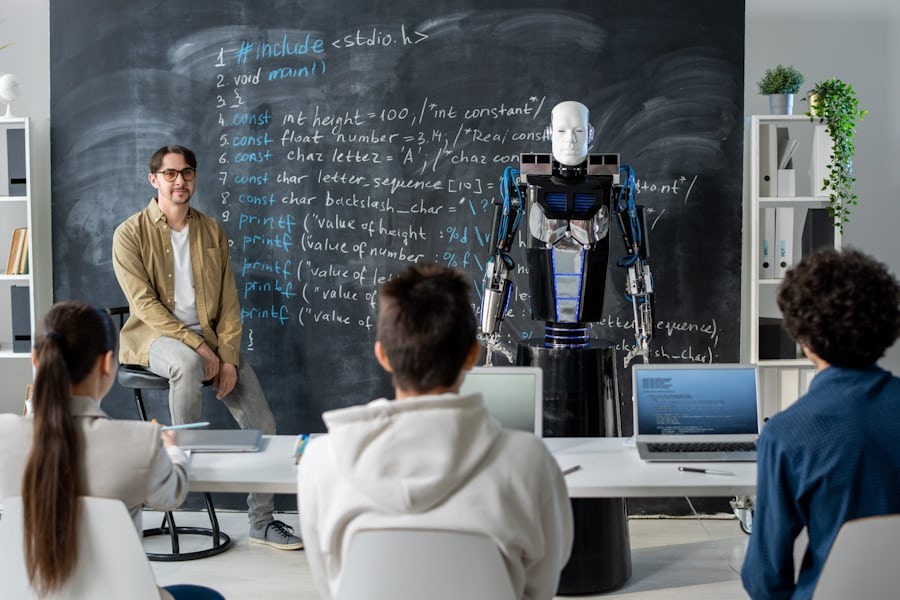
The traditional education system treats all students the same, but in reality, every student learns differently. AI is solving this problem by creating a personalized learning experience for each individual.
AI-powered education tools adjust in real time based on a student’s performance, strengths, and weaknesses.
How AI is Transforming Education
Personalized Learning: AI customizes lessons according to the student’s level, ensuring better understanding and retention.
AI Tutors: Students can get help anytime through AI tutors that explain concepts in simple and multiple ways.
Instant Feedback: AI provides immediate answers and identifies mistakes, allowing students to improve quickly.
Automated Assessment: Assignments and tests are graded automatically with detailed feedback.
Global Accessibility: Anyone with internet access can now learn high-quality skills from anywhere in the world.
Real Impact:
- Better learning outcomes
- Flexible learning pace
- Equal access to education globally
Example: A student can now learn coding, design, or any skill online without needing a physical classroom or expensive institutions.
Online Earning Opportunities Using AI
One of the biggest benefits of AI in 2026 is:
You don’t need advanced technical skills to earn with AI anymore
Here are some real opportunities:
1: Content Writing and Blogging

Content writing remains one of the highest-demand online skills, and AI has made it more accessible than ever. Businesses, bloggers, and marketers constantly need fresh, high quality content but most cannot produce it fast enough on their own.
By using AI writing tools strategically, you can create professional level content much faster than traditional methods. The key is to use AI for structure, research, and initial drafts, while adding your own human voice, personal insights, and quality control to make the content truly valuable.
You can create:
- Blog articles and SEO-optimized website content
- Social media posts, captions, and content calendars
- YouTube video scripts and podcast outlines
- Email newsletters and marketing sequences
- Product descriptions for e-commerce stores
- Press releases, case studies, and white papers
Beginner Tip: Start by offering services on Fiverr at a lower price to build reviews. As your portfolio grows, gradually increase your rates. Many beginners earn their first $100–$500 within the first month.
2: Freelancing with AI Tools

Freelancing platforms like Fiverr, Upwork, and Freelancer.com are seeing rapid growth in demand for AI-assisted services. Clients care about results not whether you use AI as long as the quality is high and delivery is fast.
By learning a few AI tools well, you can offer services that previously required years of experience or expensive software. The barrier to entry has never been lower.
Popular AI-powered freelancing services include:
- AI-assisted copywriting, blog writing, and article creation
- Graphic design and social media visuals using AI tools
- Video creation and editing with AI video tools
- Social media management and scheduling
- SEO audits, keyword research, and content optimization
- AI chatbot setup and automation for businesses
- Resume writing and LinkedIn profile optimization
Platform Strategy: Start on Fiverr with 2–3 focused services. Build reviews aggressively in the first 30 days, then expand to Upwork for higher-paying, long-term clients.
3: Affiliate Marketing
Affiliate marketing earning commissions by promoting other companies’ products is a proven online income model. In 2026, AI has made it even more powerful and beginner-friendly.
Previously, the biggest challenge was creating enough content to drive traffic. Now, with AI, you can produce and manage content at scale while maintaining quality that ranks on search engines.
AI helps with:
- Keyword Research: Finding low-competition, high-traffic keywords
- Content Creation: Writing product reviews and comparison articles
- Email Marketing Automation: Building sequences that convert subscribers
- SEO Optimization: Improving structure, internal linking, and rankings
Income Potential: Successful niche sites can generate $500 to $5,000+ per month in passive income. Reaching this level typically takes 6–18 months of consistent effort.
4: E-commerce with AI

Starting an online store has never been easier, and AI has removed many traditional barriers from product research to customer support.
Whether you run a dropshipping store, print-on-demand business, or sell your own products, AI provides capabilities that once required full teams.
AI supports e-commerce by:
- Product Research: Identifying trending and profitable products
- Listing Optimization: Writing SEO-friendly and persuasive descriptions
- Customer Behavior Analysis: Understanding buying patterns
- Ad Campaign Management: Automatically optimizing ad performance
- Customer Support: Handling queries using AI chatbots
Best AI Tools for Beginners
AI tools are widely used to increase productivity and efficiency in different fields.
1. AI Chatbots
- Used for content writing and customer support
- Can answer questions and generate ideas instantly
2. AI Design Tools
- Create logos, social media posts, and graphics
- No advanced design skills required
3. AI Video Generators
- Convert text into videos
- Useful for YouTube and social media content
4. AI SEO Tools
- Help websites rank higher on Google
- Provide keyword suggestions and optimization tips
Real Impact:
- Tasks that once took hours can now be completed in minutes.
- AI tools increase both speed and productivity.
The Future of AI and Machine Learning What Is Coming
Predicting the future of technology is never completely certain, but the direction AI is heading is already clear. We can confidently identify the major changes that will shape jobs, businesses, and online earning opportunities in the coming years.
Automation of Repetitive Work Will Accelerate
Tasks that follow predictable patterns such as data entry, basic customer service responses, routine report generation, and simple content moderation are being automated at a rapid pace. This is not a new trend; automation has existed for decades. However, AI is accelerating this process across multiple industries at the same time and with far greater speed than before.
The real question is no longer “Will my job be automated?” Instead, it is “Which parts of my work can AI handle, and what should I focus on instead?”
People who actively adapt to this shift will be the ones who succeed in the long term.
New AI-Specific Careers Are Emerging
Every major technological revolution creates new career paths, and AI is no exception. Roles such as prompt engineering, AI content strategy, machine learning operations (MLOps), AI ethics consulting, and AI tool training are rapidly growing fields that barely existed a few years ago.
Many of these careers do not require advanced coding skills. Instead, they require an understanding of how AI works, strong communication abilities, and expertise in a specific industry or subject area.
AI Will Become Infrastructure
Just like electricity and the internet became invisible foundations of modern life, AI is moving in the same direction. In the near future, almost every business application, productivity tool, and digital platform will have AI built into it.
At that point, the question will no longer be “Are you using AI?” Instead, it will simply be assumed that AI is part of everything you do.
Human–AI Collaboration Will Define Success
One of the most consistent findings across industries is that the best results come from combining human intelligence with artificial intelligence, not using either one alone.
AI provides speed, scale, and powerful data analysis. Humans provide creativity, judgment, emotional intelligence, and ethical decision-making. Together, they create outcomes that neither could achieve independently.
The most valuable skill in the future will be learning how to work with AI, not against it.
Future Prediction
By 2028, the gap between professionals who understand and use AI effectively and those who ignore it will be as significant as the gap between early internet adopters in the late 1990s and those who resisted it.
The time to prepare for that gap is now.
Key Advantages of Artificial Intelligence
1. Time Saving
AI automates repetitive tasks, allowing humans to focus on important work.
2. Increased Productivity
Work that took hours can now be done in minutes.
3. Better Accuracy
AI reduces human errors, especially in data analysis and calculations.
4. Cost Reduction
Businesses can save money by automating tasks instead of hiring large teams.
5. 24/7 Availability
AI systems (like chatbots) work all day without breaks.
6. Data-Based Decisions
AI analyzes large data to make smarter and more accurate decisions.
7. Personalization
AI provides customized experiences (shopping, content, learning).
8. Scalability
Businesses can grow faster using AI without increasing costs significantly.
Skills You Must Learn in 2026
To stay ahead, focus on these skills:
- Content writing
- Basic SEO
- AI tools usage
- Digital marketing
- Consistency and discipline
Conclusion
Artificial Intelligence (AI) and Machine Learning (ML) are transforming the way we work, learn, and earn in 2026. They are no longer advanced technologies limited to experts, but practical tools that anyone can use to build a better future.
Success today is not about working harder, but about using AI in a smart and strategic way. Whether it is online earning, freelancing, or growing a business, AI opens doors to global opportunities and faster growth.
The real success in 2026 belongs to those who learn how to use AI to earn, grow, and stay ahead in the digital world.
The journey does not require perfection. Start small, stay consistent, and keep improving your skills step by step. With the right approach, AI can help you create a stable income and a strong digital career from anywhere.
The future belongs to those who work with Ai, not against it.
Frequently Asked Questions Everything Clients and Readers Ask
This section covers the most common questions people ask about AI and Machine Learning from complete beginners to intermediate users and even technical professionals. If a question is not here, it is rare.
Q1. What is the difference between AI and Machine Learning?
Artificial Intelligence is the broader concept of creating intelligent machines that can perform human-like tasks. Machine Learning is a subset of AI that focuses specifically on learning from data. In simple words, AI is the goal, and Machine Learning is one of the ways to achieve it.
Q2. Can beginners earn money using AI?
Yes, beginners can start earning using AI by offering services like content writing, social media management, or freelancing. Many AI tools are beginner-friendly and require no technical skills. With consistency and practice, it is possible to generate income within a few weeks or months.
Q3. Do I need coding skills to use AI?
No, coding is not required for most AI tools available today. Many platforms are designed for non-technical users and work with simple instructions. However, learning basic technical skills can be helpful if you want to go deeper in this field.
Q4. What are the best ways to earn money using AI?
Some of the most popular ways include content writing, freelancing, affiliate marketing, e-commerce, and social media content creation. AI helps you work faster and more efficiently, allowing you to handle more clients or projects in less time.
Q5. Can AI make mistakes?
Yes, AI can make mistakes because it depends on data and patterns. It may sometimes provide incorrect or incomplete information. That’s why it is important to review, edit, and verify AI-generated content before using it.
Q6. Is AI a good career choice in 2026?
AI is one of the most in-demand career fields in 2026. It offers high growth, global opportunities, and multiple income streams. People who learn how to use AI effectively can build strong careers in freelancing, business, and digital industries.
Q7. How can students benefit from AI?
Students can use AI to learn faster, understand complex topics, and complete assignments more efficiently. It can also help them develop skills and start earning online through freelancing or content creation at an early stage.
Q8. What is the future of AI?
The future of AI is very promising, as it will continue to grow and become a part of everyday life. It will impact jobs, businesses, and education on a large scale. Those who adapt and learn AI skills early will have a strong advantage in the future.
Q9: Which skill is better to learn first: AI or Machine Learning?
It is better to start with basic Artificial Intelligence concepts first, then move to Machine Learning. Understanding AI gives you a clear foundation before diving into more technical topics like ML.
Q10: Which specific AI tools should I use?
The best AI tools depend on your goals and the type of work you want to do. For writing, you can use ChatGPT or Claude, while for images tools like Midjourney or DALL·E are useful. For video creation you can use Synthesia, and for SEO tools like Semrush or Surfer SEO work well.

❤️❤️🖊️🖊️